What Does "Gifted" Actually Mean?
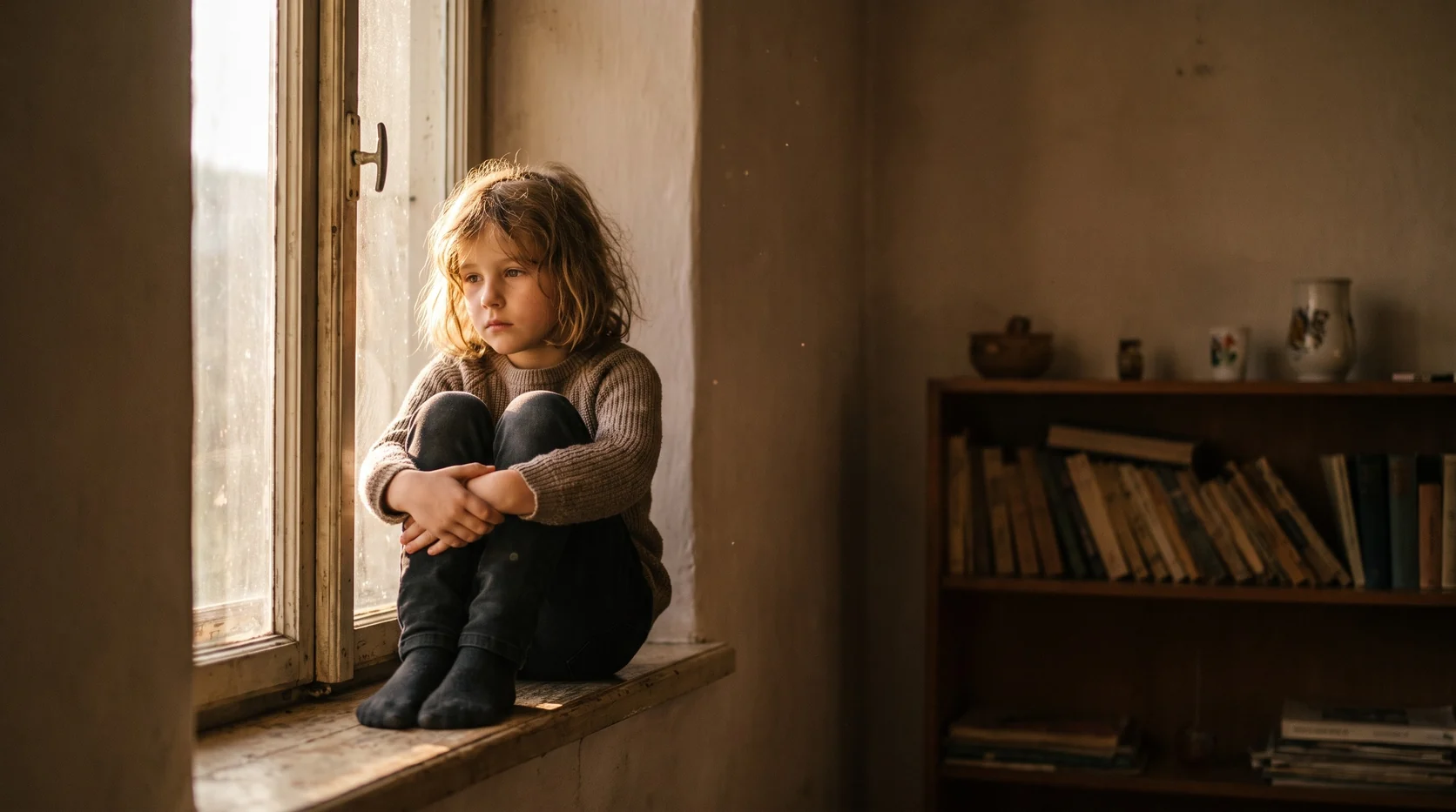
The word "gifted" rarely reaches a parent at a happy moment. It doesn't come with a diploma. It comes, usually, after a meeting with the teacher, after a crying fit nobody could explain, after the third week of a child refusing to go to school. Someone says it — a relative, a psychologist, a teacher — and instead of clarity, a bigger question appears than the one before.
It's worth starting from the beginning, because it is a word almost everyone uses incorrectly.
What the word actually describes
"Gifted" does not describe a value. It describes capability — demonstrated or still potential — to function, in one or more domains, at a level above what is typical for the age.
In some of these children, that capability comes bundled with a distinct rhythm and intensity: processing speed above their age, a strong need to understand why, early connections between seemingly unrelated things, sometimes an emotional intensity to match. These are possible experiences, not defining features — no emotional profile cleanly separates gifted children from everyone else.
Notice what is missing from that list: performance. Grades. Prizes. Results.
That is the first confusion, and the most expensive one. High potential is not the same thing as doing well in school. There are children with enormous potential who bring home mediocre grades for years, and children with excellent grades whose engine is conscientiousness, not intensity. Both are fine. But if we use the word as a synonym for "top of the class," we miss exactly the children it is about.
Giftedness is not a trophy a child receives. It is a way of functioning that the child has to learn to live with.
What it does not mean
Worth stating just as clearly, because each of these does real damage when assumed.
It is not a diagnosis. It is not an illness, not a disorder, and it appears in no medical manual. It cannot be "treated" and cannot be "cured." It is a description of how someone processes the world.
It is not a guarantee. It does not predict a brilliant career, an easy life, or a high income. What happens to potential depends enormously on environment, relationships, and support. Potential is raw material. That is all.
It is not a reason for pressure. This is where the most harm is done. A child who is told they are "special" quickly comes to believe their worth comes from performance — and then every mistake becomes a threat to their identity. Many high-potential children end up avoiding everything they are not instantly good at, precisely because they have learned they are "supposed to" be good from the first try.
It is not a label to be applied at home. A parent can observe. A parent can wonder. But a real assessment is done by a licensed psychologist, with validated instruments, in a setting that accounts for age, cultural context, and how the child is doing that day. It is not done from an article, from an online checklist, or from a conversation with an artificial intelligence.
Why the word usually arrives at a hard moment
Because development doesn't come as a package.
There is a phenomenon that specialists call asynchronous development: a child's mind can run years ahead of their body and their emotional maturity. A five-year-old can ask questions about death, infinity, or injustice — and that same afternoon fall apart because a biscuit broke. That is not a contradiction. It is simply three different ages living in one child: an intellectual one, an emotional one, a physical one.
That asynchrony can explain the situations in which the word comes up for the first time:
- The child grasps a complex idea, but cannot bear losing a game.
- Reads fluently, but cries when asked to write by hand.
- Has an unusually strong sense of justice and gets into conflicts over things other children let pass.
- Is bored in class and, instead of looking brilliant, looks distracted, rude, or lazy.
The last one is especially easy to misread. A child who finishes the exercise in two minutes and then has forty minutes of waiting does not behave like a happy child. He behaves like a captive one.
What you can observe, without labels
Not as a checklist — as questions worth watching over weeks, not over one evening.
Where does their attention go when nobody asks anything of them? Some high-potential children have a zone they sink into completely, losing all sense of time. Where is that zone?
What kind of questions do they ask? The difference is not in quantity. It is in the type: questions about mechanism, about cause, about "what would happen if."
How do they react to a mistake? A disproportionate reaction to a small mistake is often the sign of an internal standard nobody installed from outside.
What happens when they are bored? Repeated, intense boredom can signal a mismatch between what is asked of them and what they can do — one possible explanation among several, worth checking before calling it laziness.
Who do they prefer to talk to? Some children with a different rhythm seek out older children or adults — not out of arrogance, but because that is where they find the conversation they need.
None of these signs, taken alone, means anything. Together, repeated over time, they can be a signal that it is worth looking more closely.
The first small step
It is not booking a test. It is changing the question.
Most parents arrive here asking "is my child gifted?" — a question with a yes/no answer that, whichever way it falls, changes nothing on Monday morning.
The question that changes something is a different one: "What does this child need, exactly as he is right now, so that he doesn't shut down?"
It is a less spectacular question and a far more useful one. It can be answered without any assessment, without any label, and without waiting for anyone. It has concrete answers: a subject to go deep into, an adult who takes his questions seriously, a place where mistakes cost nothing, a rhythm that doesn't leave him waiting for forty minutes.
If at some point a formal assessment becomes useful — for school, for a program, for a concrete decision — it happens then, with a specialist, and it is a tool, not a verdict. But it is not the first step. It is, at most, the third.
And in the meantime, the child is not waiting for a diagnosis. He is waiting to be seen.
Do you have a real situation, not a perfect question?
Describe to Fractalia AI what you're seeing in your child — what you've tried, where things get stuck, what you want to understand. You don't get a label. You get a map of the context, the pattern behind it, and one small first step to test this week.
Ask your real question — free5 free AI responses · quick sign-up
Fractalia AI supports parental reflection and clearer thinking. It does not provide diagnosis, therapy, or medical or psychological advice. For situations that seriously worry you, contact a qualified professional.